
Your Scottish Wedding
Scottish Wedding Traditions: The Quaich Ceremony Explained
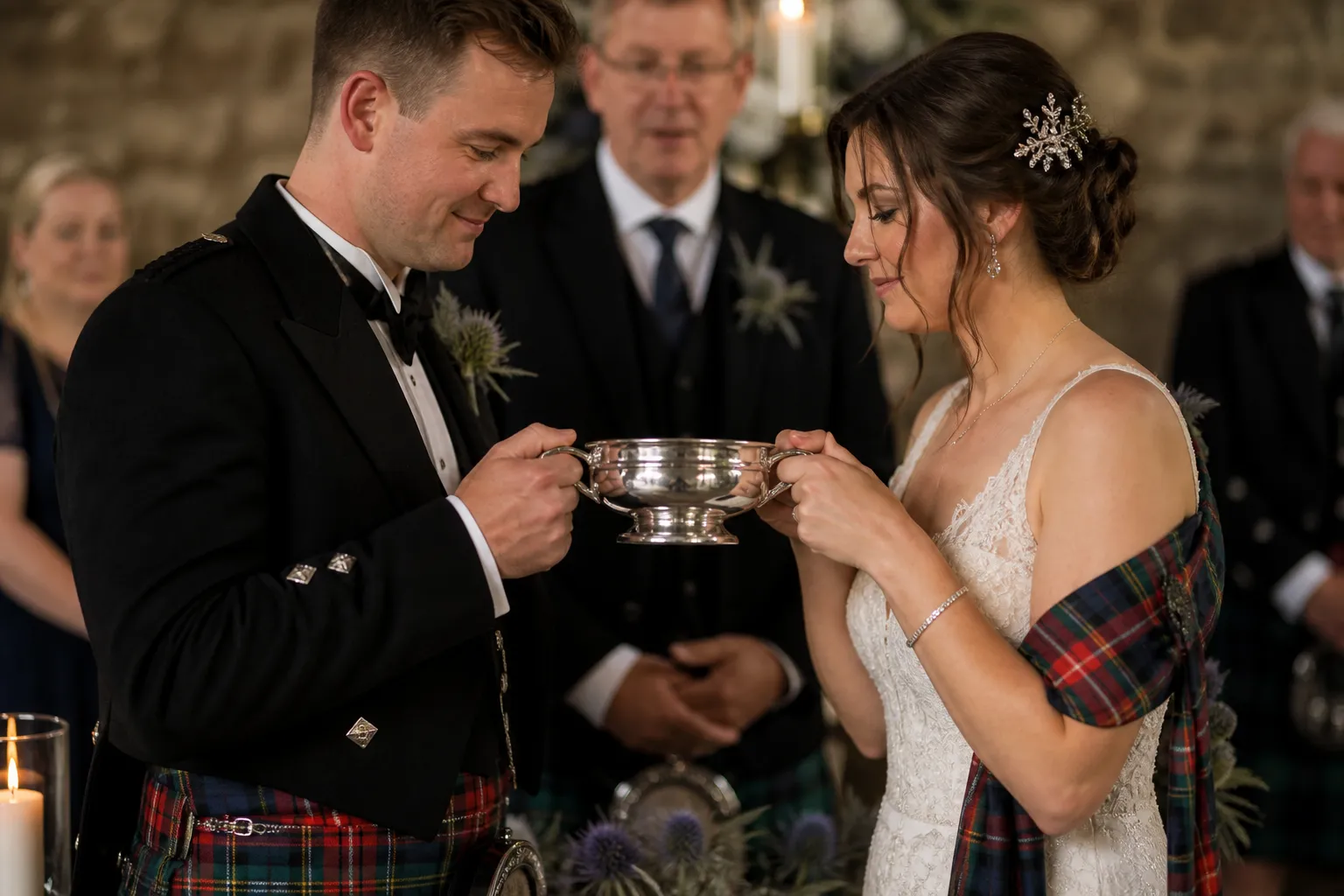
A quaich ceremony can be a simple, generous moment within a Scottish wedding: a shared cup used to mark welcome, connection or the joining of families. Its value comes from the meaning the couple gives it and from a calm, well-prepared handover.
This practical guide focuses on choices that can be agreed clearly before the wedding. It is intended to help the organiser turn a good idea into a considerate plan, while leaving the couple free to make it their own.
Start with your own interpretation
Decide what sharing the quaich will represent in your ceremony. It may speak to hospitality, partnership, family connection or a new beginning. There is no need to borrow language that does not feel like yours; a brief personal explanation can give the ritual more weight than a formal script.
Choose where it belongs
Discuss the position of the quaich ceremony with the celebrant. It can sit around the legal declarations, but it does not replace the required legal element of a marriage ceremony. Placing it deliberately helps guests follow the flow and gives the couple time to be present in the moment.
Decide who takes part
The couple may share the cup alone, invite close family, or ask someone to introduce it. Choose participants because the connection matters, not because tradition is being performed for an audience. Anyone asked to drink, hold the cup or speak should be able to decline comfortably.
Choose the contents thoughtfully
Decide what, if anything, will be in the quaich and make alcohol-free participation straightforward. Consider practical matters such as allergies, dietary requirements and whether the cup is intended for more than two people. A simple, clear decision avoids assumptions at a sensitive point in the ceremony.
Prepare the object for use
Check that the quaich is clean, stable, appropriately sized and easy to hold. Work out where it waits before the ceremony, who carries it forward and where it goes afterwards. These small details stop an intimate ritual becoming a public search for a missing or unsuitable item.
Write a short introduction
One or two sentences can tell guests what the quaich means to you without over-explaining it. Put the wording in the celebrant’s notes and read it aloud before the day. The best introduction sounds like the couple, rather than a borrowed historical commentary.
Rehearse the exchange
Practice how the cup is handed over, held and returned, especially if it will be filled. A quick rehearsal can prevent spills, awkward reaching or uncertainty about who moves next. The goal is not a choreographed performance; it is enough familiarity to let the moment remain relaxed.
Plan photographs with discretion
Tell the photographer where the quaich ceremony happens and which gestures matter. They can prepare without stepping into the space or asking for a repeat. A well-observed image is more valuable than interrupting a personal exchange in pursuit of a perfect frame.
Check names and pronunciation
If Gaelic words, family names or readings are included, provide phonetic guidance and confirm it with the people whose language is being used. This care supports the ceremony’s meaning. It also prevents a heartfelt tribute from being undermined by a hurried approximation.
Keep heritage honest
If the quaich connects to a particular family, place or story, name that connection. Avoid suggesting that one account speaks for every Scottish wedding. Specificity is more respectful and often more moving, because guests can see why this ceremony belongs to you.
Arrange its care after the ceremony
Choose someone to empty, clean and store the quaich once it has been used. If it will be engraved or become a keepsake, note that plan before the reception begins. This is a small act of care that keeps the object from being misplaced during a busy celebration.
Confirm the final ceremony cue
In the final fortnight, check the wording, participants, contents, placement and handover with the celebrant and one trusted helper. Keep the agreed sequence with the ceremony schedule. Preparation gives a quaich ceremony the quiet confidence that lets its shared meaning come through.
Make kindness operational
Consider which part of quaich ceremony might be hardest for a guest to navigate quietly: cost, travel, confidence, access, food or the pace of the day. Then make one practical adjustment before anyone needs to ask. Thoughtful arrangements are most effective when inclusion is built into the plan rather than offered as an exception.
Use the plan to reduce pressure
The purpose of a written approach to quaich ceremony is not to make a celebration formal. It is to remove avoidable uncertainty so people can be more present. Once arrivals, choices and responsibilities are clear, the organiser can stop sending reminders and the guests can focus on the conversation, ceremony or shared experience in front of them.
Leave the final choice with the couple
Advice about quaich ceremony is most useful when it helps the couple decide what matters to them. They do not need to include every appealing option or follow somebody else’s version of the occasion. A plan that reflects their priorities, communicated honestly and carried out considerately, will always have more lasting value than a busy imitation of another wedding.
Protect the reason for the occasion
Return once more to the human purpose of quaich ceremony. The plan should make it easier to celebrate, connect, travel safely or take part with confidence, according to what the occasion needs. If a decision serves only appearance or group pressure, it can usually be simplified. That final filter keeps the arrangements warm, practical and recognisably personal.
Make the first decision reversible
At the early stage, treat the first choice about quaich ceremony as a direction rather than an irreversible verdict. Keep alternatives visible until dates, group numbers and practical constraints are known. That approach helps the organiser spend attention where it matters, and stops an attractive initial idea from becoming difficult to adjust simply because it was announced too soon.
Use a short decision record
For quaich ceremony, record what has been agreed, who owns the next action and the date it must be confirmed. This need not become a complicated spreadsheet: a single shared note is enough. Its value is that it separates confirmed arrangements from hopeful suggestions, giving everybody a reliable reference when messages begin to multiply.
Ask the question behind the preference
When someone has a strong preference about quaich ceremony, ask what outcome they are trying to protect. They may be seeking comfort, connection, time together, privacy, accessibility or a particular mood. Understanding the underlying aim often reveals several workable solutions and avoids treating one person’s first proposal as the only route to a good day.
Share information in layers
Not every guest needs the full planning file for quaich ceremony. Send each person the practical details that affect them, while keeping private budgets, personal preferences and contingency conversations with the people who need to act on them. This makes communication clearer and protects the dignity of anyone whose circumstances are not for the whole group to discuss.
Leave room for human timing
A good quaich ceremony plan recognises that people take time to arrive, decide, eat, rest and say goodbye. Avoid designing every transition as though it were frictionless. A little margin does more than protect a schedule: it lets the people involved notice the occasion instead of experiencing it as a sequence of instructions.
Check the experience from a guest’s view
Read the arrangements for quaich ceremony as if you had received them without the background conversations. Could you understand where to go, what it costs, what is optional and who can help? This simple test identifies assumptions that organisers may no longer see, and it often improves the experience without adding expense or spectacle.
Keep a proportionate contingency
The most helpful backup for quaich ceremony is usually specific and modest. Name the decision that would change if weather, timing, access or attendance shifts, then agree who will make the call. A proportionate fallback keeps the original intention visible while preventing uncertainty from spreading through the whole plan.
End the planning with one clear version
In the final fortnight, retire old messages and issue a settled summary for quaich ceremony. Include the relevant time, place, contacts, responsibilities and any voluntary choices. This last piece of editing is a kindness to the couple and guests alike: it makes the live experience feel natural because the administration has already been resolved.
Keep expectations realistic
Good quaich ceremony planning does not promise perfect weather, identical moods or effortless timing. It makes the important choices visible and leaves room for ordinary human unpredictability. If a small part changes, the group can respond without losing sight of the reason for gathering: a wedding occasion should feel cared for, not controlled.
Planning for scottish wedding traditions
When comparing scottish wedding traditions, confirm availability, complete costs, timings and what is included before paying a deposit.
Continue with Your Scottish Wedding planning inspiration and use VisitScotland for wider destination and travel context.
Three useful booking questions
- What should we confirm first when comparing scottish wedding traditions?
- How early should couples book scottish wedding traditions?
- Which complete costs apply to scottish wedding traditions?
A final review of scottish wedding traditions should compare quality and complete costs. Shortlist scottish wedding traditions only after checking availability and terms. Ask suppliers about scottish wedding traditions before paying a deposit.
Compare scottish wedding traditions using a written shortlist. Review scottish wedding traditions after every quotation arrives. Confirm the final choice of scottish wedding traditions only after checking all terms.