
Wearing the story
Please click here to listen to this article
A kilt is so much more than formalwear. It’s heritage, identity and, for many grooms, a shift in how they carry themselves. Here, three Scottish kiltmakers explain what really happens at the fitting.
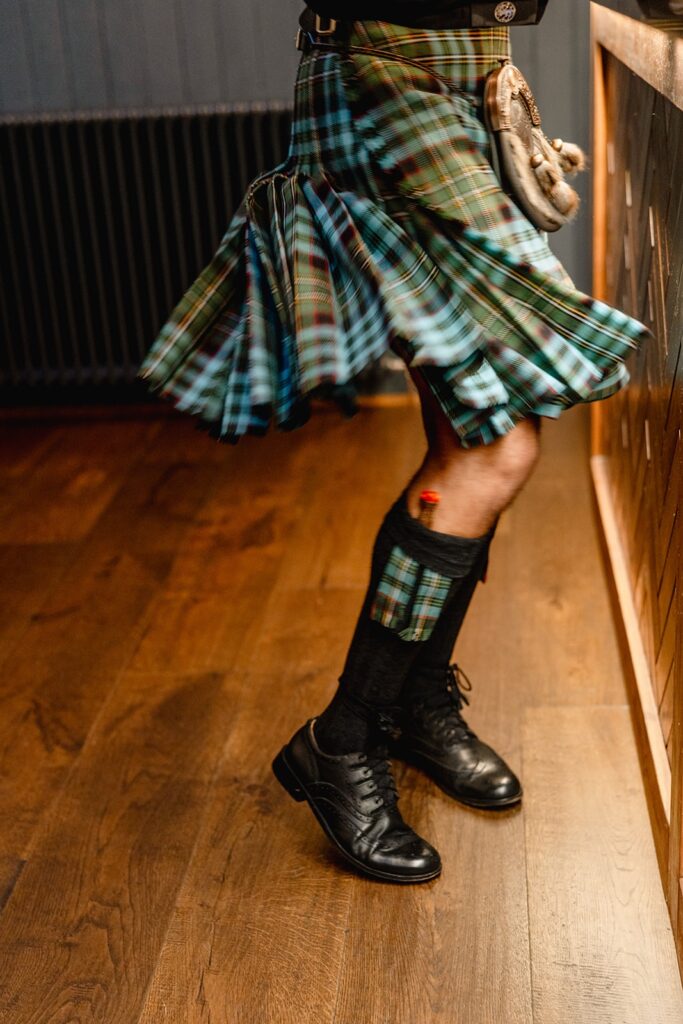
The moment it clicks
There’s a point in every kilt fitting, says Gordon of Gordon Nicolson Kiltmakers (GNK), when something shifts. It happens gradually. With each component added in the proper way, the full picture slowly comes together. Finally, the groom stands in front of the mirror and sees himself properly for the first time.
“His confidence grows as he realises how good the outfit looks on him,” Gordon explains. And the small adjustments matter as much as the big ones, from a sporran at the right height to a waistcoat buttoned correctly. These are the details that take an outfit from almost there to exactly right. “By this point, the groom is standing taller, fully relaxed and feeling 100% ready for his day.”
At Kilts 4 U, the team know first impressions hit fast. “We never have him leaving a fitting room without looking the part,” says Iain. “It’s a truly proud moment, for him and for us.”
Levi of McCalls Highlandwear recognises something else in that moment too. “For a lot of grooms, it’s when the day starts to feel real. Up until then, the wedding can still feel like plans and to do lists. Seeing themselves fully dressed in a properly fitted kilt is often when it all clicks into place. There’s a real sense of pride in that.”
For many grooms, it’s the first time they’ve ever worn a kilt so the nerves are real. What all three makers have found, though, is that the nerves don’t last long.
More than cloth
Ask any of these kiltmakers what surprises people most about a properly made kilt and the answer starts with the work involved. A traditional kilt uses at least eight yards of tartan; enough to give it the volume to move when you walk and return to perfectly neat pleats. All of Gordon’s tartans are woven in Scotland while some of the 16 tartans at Kilts 4 U can only be crafted in one mill in the world, because it’s the only one with the technology to do so.
“Most people have no idea what’s actually involved,” says Gordon. Every stage of GNK construction is done by hand, by kiltmakers trained at the Edinburgh Kiltmakers Academy. There may be hidden pleats, extra fabric folded invisibly into the structure or careful built-in excess that allows for adjustments and repairs over the years. “A good kilt can last forever if you treat it well. One day you can even pass it on to the next generation.”
Levi puts it simply: “It takes skill, structure and time – from the way the tartan is matched and pleated through to the finishing details that give it shape, movement and longevity.” McCalls has a video on its website showing every stage of the process. “Even after working here for five years, I was still surprised by just how much work goes into making one. It really is a craft; a labour of love.”
That longevity is something Kilts 4 U returns to too. “Is there another garment you can truly say should fit you all the way through your life then be handed proudly down through generations?” asks Iain. The answer, of course, is no. A kilt doesn’t go out of fashion. Instead, it gathers meaning.
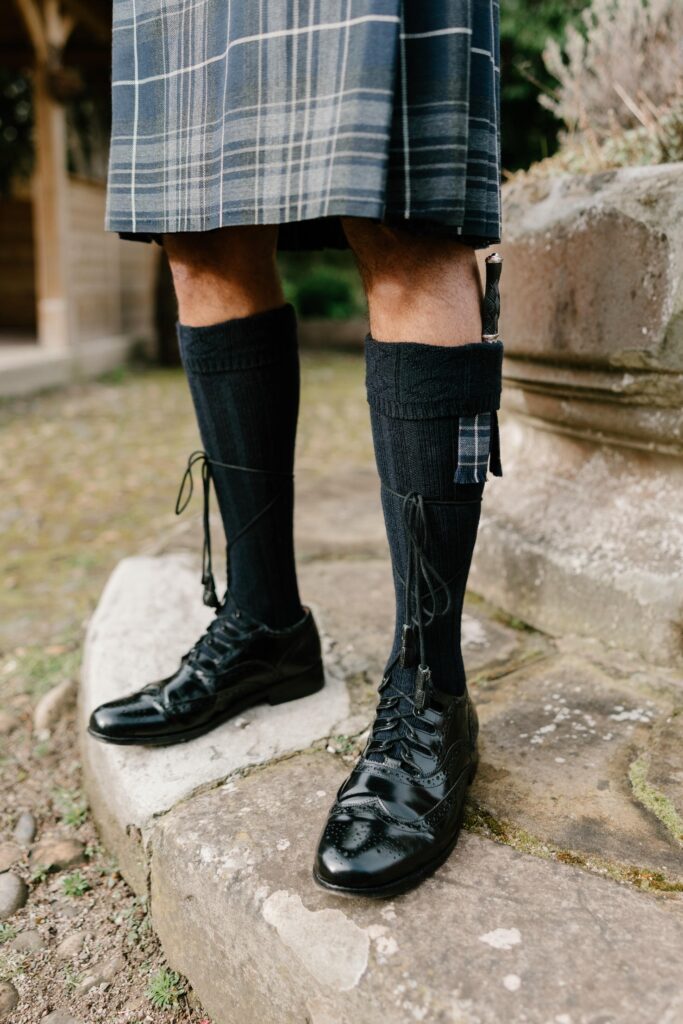
Where the heart is
The tartan question is rarely straightforward. For some grooms it’s a practical choice, like a colour scheme built around the wedding palette; the rest of the day taking its lead from the cloth. For others it carries something heavier – possibly a family tartan worn by a previous generation, in many cases someone no longer alive to see the day.
That choice shapes everything that follows, from the jacket tones to the sporran and accessories. When a kilt is made to measure it can be built as a complete, considered outfit. Individually styled and one of a kind; made for the biggest day of your life.
Gordon encourages every groom to see the outfit as an expression of himself rather than a uniform to be worn correctly. Subtle choices (the colour of a tie or the style of a sporran) can transform a look just as dramatically as bolder decisions. “The important thing is that the groom expresses himself, building his own individually styled outfit from the kilt up.”
For Levi, the balance between tradition and self-expression is the heart of it. “It’s never about choosing between the two. The beauty of Highlandwear is that it allows both. You can respect the history and craftsmanship behind it while still creating an outfit that reflects your personality and the way you want to present yourself.” McCalls’ strapline captures it neatly: Scottish Heritage Meets Modern Style.
And wherever in the world you marry, a kilt carries its meaning. “No matter what country the wedding is taking place, if a kilt is the chosen attire, you know where the groom’s heart is from,” smiles Iain.

When the generations come in together
There’s one kind of fitting that stands apart from the rest. When multiple generations (grandfather, father, groom, son) arrive together, something different happens in the room.
“You hear family stories,” explains Levi. “You see different tastes and personalities come through, and sometimes there’s real emotion. It’s a reminder that Highlandwear isn’t just about dressing for the day, but about family, connection and occasion.”
It’s a moment that no to do list prepares you for, and one that makes the whole craft worth it.