Ceremony myths busted
- ThePlus Audio
Please click here to listen to this article
Did you know there are actually no prescribed vows in Scottish marriage ceremonies?
In other words (no pun intended!) you don’t have to promise to do anything – least of all ‘honour and obey’ your other half.
The only must is a few words that Scots Law insists upon (“I [name] accept [name] in marriage”) as you exchange rings, should you choose to do so… More on that later!
With all this in mind, YSW quizzed Scottish celebrants on other common myths.
So, let’s cut through the superstitions and misconceptions and get to the heart of what you need to know as you prepare to wed…

The myth…
You can’t mention religion in humanist ceremonies:
The reality:
“A humanist wedding is all about the couple; making the ceremony reflect them as far as is possible so I allow religious readings if they want that.
“Not all humanists and organisations would, however, so ask early on if it’s important to you.
“This situation often comes up because the couple wants a humanist ceremony but their family are keen to include a religious element.
“This is a good compromise that keeps everyone happy.
“I don’t do the religious reading – one of the guests will and, normally, the honour is taken on by one of the loved ones who prompted the inclusion of religion.
“A popular choice for a humanist ceremony is a reading from the first letter of St Paul to the Corinthians (12:31 – 13:8)”.
Gordon Bond, Independent Humanist Ceremonies

The myth…
You have to include symbolic gestures and exchange rings with your partner.
The reality:
“Some to-be-weds think that if you’re to be married by a celebrant you have to include symbolic gestures, such as handfasting or drinking from the quaich.
“They also think you must exchange rings. But that’s not the case.
“Whilst symbolic gestures and exchanging rings are still really popular and make for a meaningful part of many wedding ceremonies, they do not have to be included.
“Like all things in your ceremony (apart from the legal declaration, of course) the content is completely up to you!
“Instead of exchanging rings some couples pin tartans onto each other’s clothes, exchange watches or get tattoos.”
Gary Smith, Humanist Society Scotland

The myth…
Keen to-be-weds can get engaged then legally marry the next day.
The reality:
“The idea that a couple can get engaged one day then get married the next is quite common when they aren’t aware of the legal process.
“For this reason, I always outline the legal requirements (which are very important and kick into place three months before the wedding date) on my first meeting with a couple.
“They can only enter into marriage, unless in exceptional cases such as a terminal diagnosis, within three months of their wedding date by submitting Marriage Notices to the Registrar in the district they are getting married in (it’s important to highlight that this is where they’re tying the knot, not where they live)!
“These notices are what most couples come to know as M10 forms and they can be downloaded from the Official Registrars website.
“The Marriage Notices need to be completed by both of you, then submitted – usually with your birth certificates plus an admin fee (currently £45 each) – 10 to 12 weeks prior to the wedding date, and no later than 29 days before your special day.
“I always recommend contacting the registrar beforehand to make an appointment.”
Norrie Flowers, Independent Humanist Ceremonies
The myth…
A guest can stop a ceremony by responding to a variation of “If anyone can show just cause why they may not be lawfully wed, speak now or forever hold your peace.”
The reality:
“This phrase, or one similar, was actually said in every ceremony until very recently so it’s a very new myth!
“There was always the chance that somebody might be forced into a marriage they didn’t want, or that parents or other legal guardians were opposed to a marriage.
“And given that it was possible for people simply to declare their intention to marry and do so, it was a sensible precaution.
“The reason we don’t have to do it in a humanist ceremony now is that we know our clients better and can make the judgement ourselves about the nature of the marriage.
“I can’t imagine anyone would choose to marry in a ceremony where they have to explain why they love one another if they weren’t absolutely convinced that this was precisely what they wanted to do.”
Tim Maguire, Celebrate People
The myth…
You’re not allowed to see your other half on the wedding morning.
The reality:
“Many things that used to be a no no for ceremonies are allowed (and encouraged and celebrated) now.
“Seeing one another before the vows is one of those things. Some couples now organise ‘first look’ photos while others spend the night before and/or morning of the wedding together, getting ready for the big event.
“As celebrants we’re in the lucky position of seeing and hearing pre- and post-ceremony plans like this from our couples and one of my favourite new traditions
is a ‘first touch’ experience.
“Couples getting involved in this popular trend stand at opposite sides of a cornered room or corridor, ensuring they can’t see one another.
“Without sight it means so much whilst preserving the ‘big reveal’ moment on the aisle.”
George McLean, Fuze Ceremonies
The myth…
Your chief bridesmaid and best man should be your witnesses.
The reality:
“The law states that your two witnesses can be anyone, provided they’re sixteen or over and able to understand the legal declarations.
“Traditionally, couples opted for the best man and bridesmaid.
“But as they’re already a key part of the wedding, choosing other loved ones can be a great way to give them a role.
“We advise choosing people who would be honoured and thrilled that you thought of them.
“It could be a parent, a grandparent or someone else who’s influenced your life.
“And my suggestion would be to consider not telling them – or anyone!
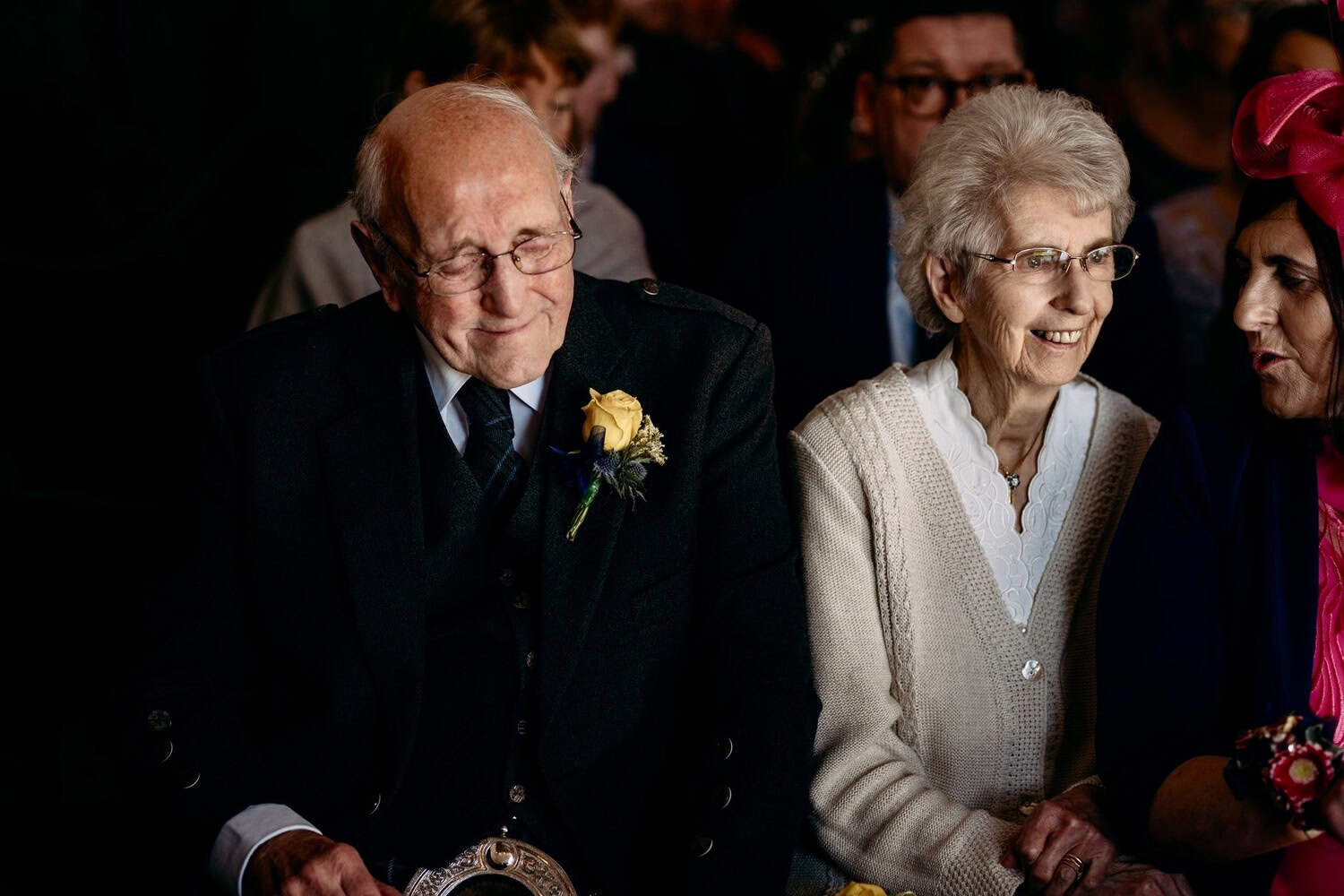
“Keeping this secret until the ceremony can create a really special moment, like the magic that happened during Gail and Craig’s wedding [pictured].
“I’d said: ‘Witnesses at a marriage ceremony have to be special and today’s witnesses are incredibly special.
“These two amazing people have been married to each other for over 60 years and everyone in their family loves them so much.
“Gail and Craig would be honoured if Craig’s grandparents, Alistair and Grace, would be their witnesses.’
“At that moment in the wedding video, Craig’s grandad can be heard saying: ‘Aw Grace, they must think an awful lot of us.’
“So, never waste a chance to create more love in a room.”
Jennifer Buchan, Humanist Society Scotland
Got another ceremony myth to bust?
Let us know at editorial@yourscottishwedding.co.uk